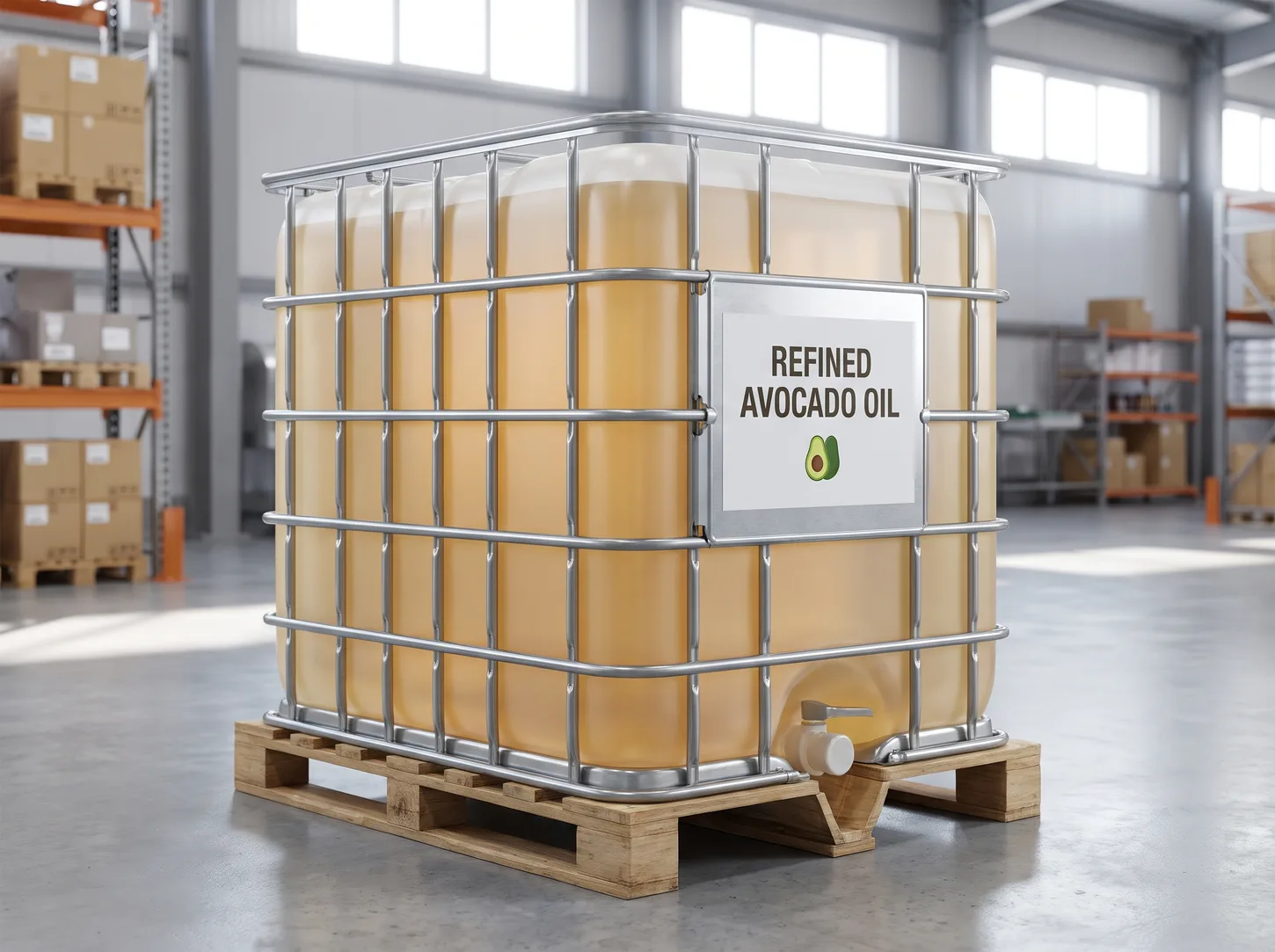
Refined avocado oil is avocado oil that has been cleaned up after pressing, usually through refining, bleaching and deodorising (often shortened to "RBD"), with degumming first and sometimes winterising after, to remove free fatty acids, colour and odour compounds. The result is a pale, mild, neutral-tasting oil, while the fatty acid profile of the oil stays much the same.
If you buy oil for a kitchen, a food factory or a cosmetics line, it helps to know what "refined" means on a label or a specification sheet. Below we walk through each step in plain words, what it removes, what it changes and what it does not, and how refined avocado oil compares with crude and extra virgin oil.
What does "refined" mean for avocado oil?
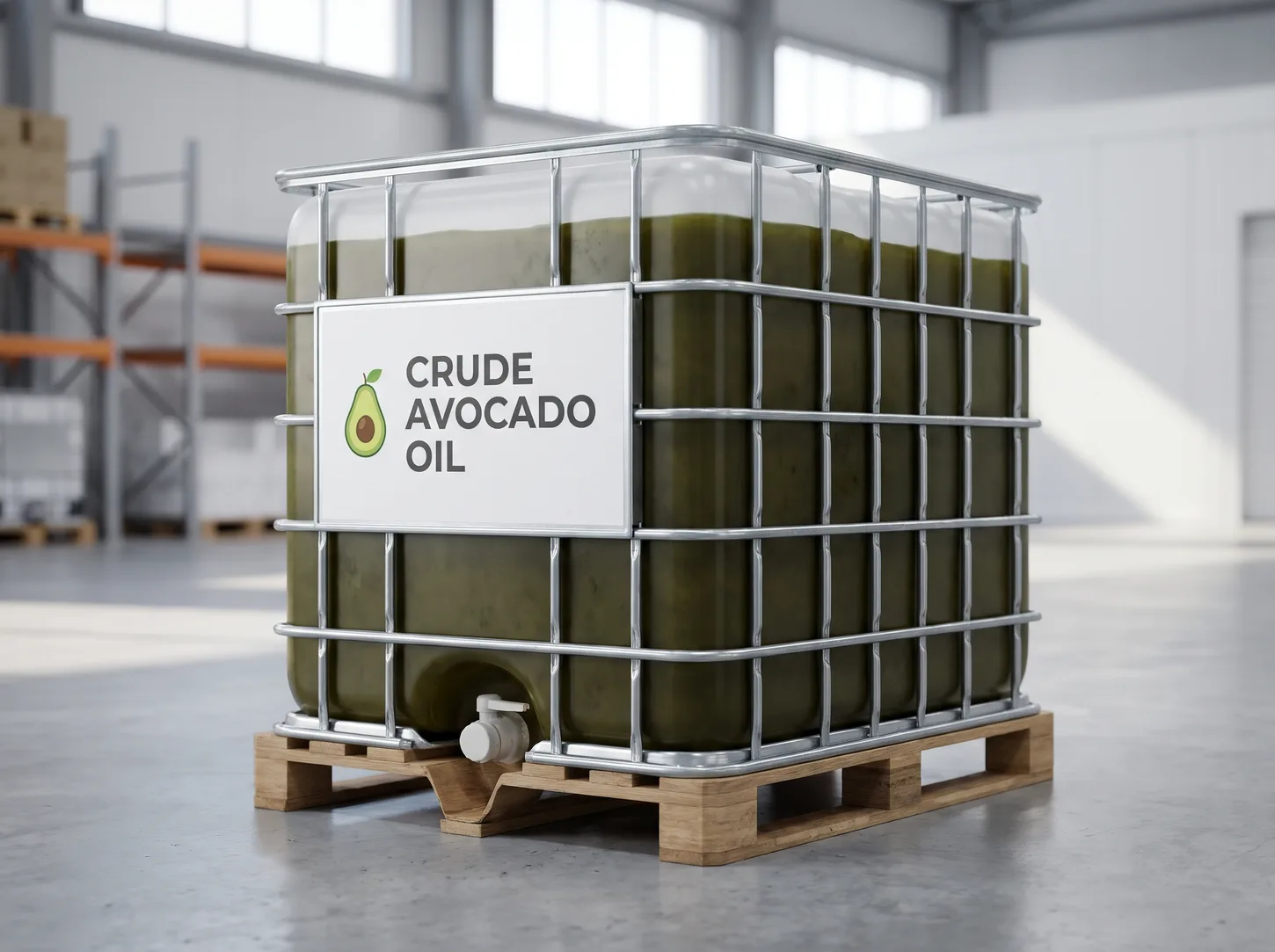
Oil pressed from avocado fruit is called crude oil. It carries more than oil: small amounts of gums, free fatty acids, pigments, moisture and the compounds that give it a strong smell and taste. Refining is the set of steps that takes those out.
The Oklahoma State University extension fact sheet on crude oil refining lists the steps "commonly used for edible oil production": degumming, deacidification (refining), bleaching, deodorisation and winterisation. These are the same general steps used across the edible oil industry, and they apply to avocado oil too.
A 2024 study in the South African Journal of Chemical Engineering followed screw-pressed avocado oil through the refining stages and concluded that "refining is a necessary step to achieve avocado oil with high-quality attributes".
The refining steps, one by one
1. Degumming
Crude oil contains phospholipids, often called gums. The Oklahoma State fact sheet notes that they have adverse effects on the colour and flavour of oil, so they are removed first, usually by treating the oil with water or acid so the gums separate out.
2. Neutralising (deacidification)
Free fatty acids (FFA) are fatty acids that have broken away from the oil's main molecules. Oklahoma State explains that they speed up oxidation, which lowers the oil's stability, and that some can give a soapy or rancid flavour. They are removed either with an alkali (chemical refining) or by steam distillation (physical refining). The fact sheet gives an industry rule of thumb that refined oils should hold less than 0.1 percent FFA.
3. Bleaching
Bleaching does not use household bleach. The oil is mixed with an adsorbent, a fine clay or earth, which is then filtered off. Oklahoma State notes that bleaching was first used to remove colour compounds such as carotenoids and chlorophyll, the pigments that make crude and extra virgin avocado oil green. Today it also removes peroxides, trace metals, soaps and other unwanted compounds.
The 2024 avocado oil study found that after bleaching, free fatty acids fell by about 53 percent and the peroxide value by about 59 percent compared with the crude oil. It also found no significant change in fatty acid composition during refining.
4. Deodorising
Deodorising is a steam-distillation step carried out under vacuum. Oklahoma State describes it as stripping out "volatile and odoriferous compounds" with steam, with the aim of producing "a bland and stable product". It also takes out remaining free fatty acids and other compounds behind off-flavours.
5. Winterising (for some grades)
Some oils are also winterised: chilled so that waxes and higher-melting fats come out and can be filtered off. Oklahoma State notes that these compounds can make oil cloudy. A winterised refined oil is often labelled RBDW.
What refining changes, and what it doesn't
| Crude / extra virgin avocado oil | Refined (RBD) avocado oil | |
|---|---|---|
| Colour | Green to deep green-gold, from chlorophyll and carotenoids | Pale yellow; most pigments taken out by bleaching |
| Taste and smell | Fruity, grassy, "avocado" | Mild and neutral |
| Free fatty acids | Higher | Lowered by neutralising and deodorising |
| Fatty acid profile | Mostly monounsaturated | Little change from refining |
| Minor compounds | Keeps more of the fruit's natural pigments and aroma | Some minor compounds are reduced along with the colour and odour |
| Typical use | Dressings, drizzling, products where the avocado flavour is wanted | Everyday cooking, food manufacturing, cosmetics where a neutral oil is wanted |
Penn State Extension makes a useful point about the trade-off: bleaching and deodorising take out unwanted compounds, but they also remove some of the oil's naturally occurring components along with them. That is why refined and extra virgin oils serve different purposes rather than one simply being "better". We cover the full side-by-side in our article on refined vs unrefined avocado oil, and the colour question in why some avocado oil is green and some pale.
Who buys refined avocado oil, and why?
- Food manufacturers choose refined avocado oil when they want the oil to carry other flavours, not add its own, for example in mayonnaise, dressings, sauces and snacks.
- Cooks and kitchens use it as an everyday oil because of its mild taste.
- Cosmetic and personal care brands often prefer a pale, low-odour oil so it doesn't colour or scent their creams, soaps and body oils.
- Private label brands use it when they want a light, neutral oil on the shelf.
A buyer's checklist for refined avocado oil
When you ask a supplier about refined avocado oil, it helps to agree on:
- Grade: refined for food, or refined and winterised (RBDW) for cosmetic use.
- Specification: ask for the specification sheet and agree the limits that matter to you, such as free fatty acids, peroxide value, colour and moisture.
- Where the crude oil comes from: who presses it, and who refines it.
- Packaging and shipping: bulk, wholesale or private label, and the Incoterm.
- Documents: the certificates and export documents your market needs.
How Imara can help
We at Imara Avocado Factory, in Thika, Kenya, offer crude, refined, extra virgin and organic avocado oil. We make most of our crude oil ourselves, especially for specialised orders, and we refine it ourselves, in our own refinery in Thika. We then transport it ourselves, in our own ISO tanks.
Our refined oil comes as RBD for food and as RBDW for cosmetic use. You can buy it in bulk from 1 container (23 t, one flexitank), wholesale under the Imara brand from 5 pieces, or under your own brand in 250 ml, 500 ml or 1 L, bottle or spray, from 100 bottles per SKU. We work EXW Thika, with FOB, CFR or CIF on request. We hold an AFA export licence (Kenya) and China GACC registration.
See our refined avocado oil page and our refinery, or contact us to ask about specifications and a proforma.
FAQ
Is refined avocado oil still avocado oil?
Yes. Refining removes gums, free fatty acids, pigments and odour compounds, but it doesn't swap the oil for another one. The 2024 avocado oil study found no significant change in fatty acid composition through the refining stages.
Why is refined avocado oil pale instead of green?
The green colour comes from chlorophyll and carotenoids. The bleaching step removes most of these pigments, so refined oil is pale yellow.
Does refined avocado oil taste of avocado?
Very little. Deodorising strips out the volatile compounds behind the smell and taste, leaving a mild, neutral oil.
What does RBD mean?
RBD stands for refined, bleached and deodorised. RBDW adds a winterising step, which removes waxes that can cloud the oil when it is cold.
Is refined avocado oil the same as extra virgin?
No. Extra virgin avocado oil is pressed and not refined, so it keeps its green colour and fruity taste. Refined oil goes through the steps above.
Sources
- Dunford, N. T. Oil and Oilseed Processing III: Crude Oil Refining and Preparation for Biodiesel Production. Oklahoma State University Extension, Robert M. Kerr Food & Agricultural Products Center, fact sheet FAPC-160. extension.okstate.edu
- Schaufler, R. and Schaufler, D. Processing Edible Oils. Penn State Extension, updated 2025. extension.psu.edu
- Satriana, Maulida, A., Qardhawi, R., Syamsuddin, Y. and Supardan, M. D. "Effect of refining process on some quality attributes of screw-pressed avocado oil." South African Journal of Chemical Engineering 50 (2024): 20–26.
- Flores, M. et al. "Avocado Oil: Characteristics, Properties, and Applications." Molecules 24, no. 11 (2019): 2172. doi:10.3390/molecules24112172
Explore all avocado oil products · Crude avocado oil · Refined avocado oil.