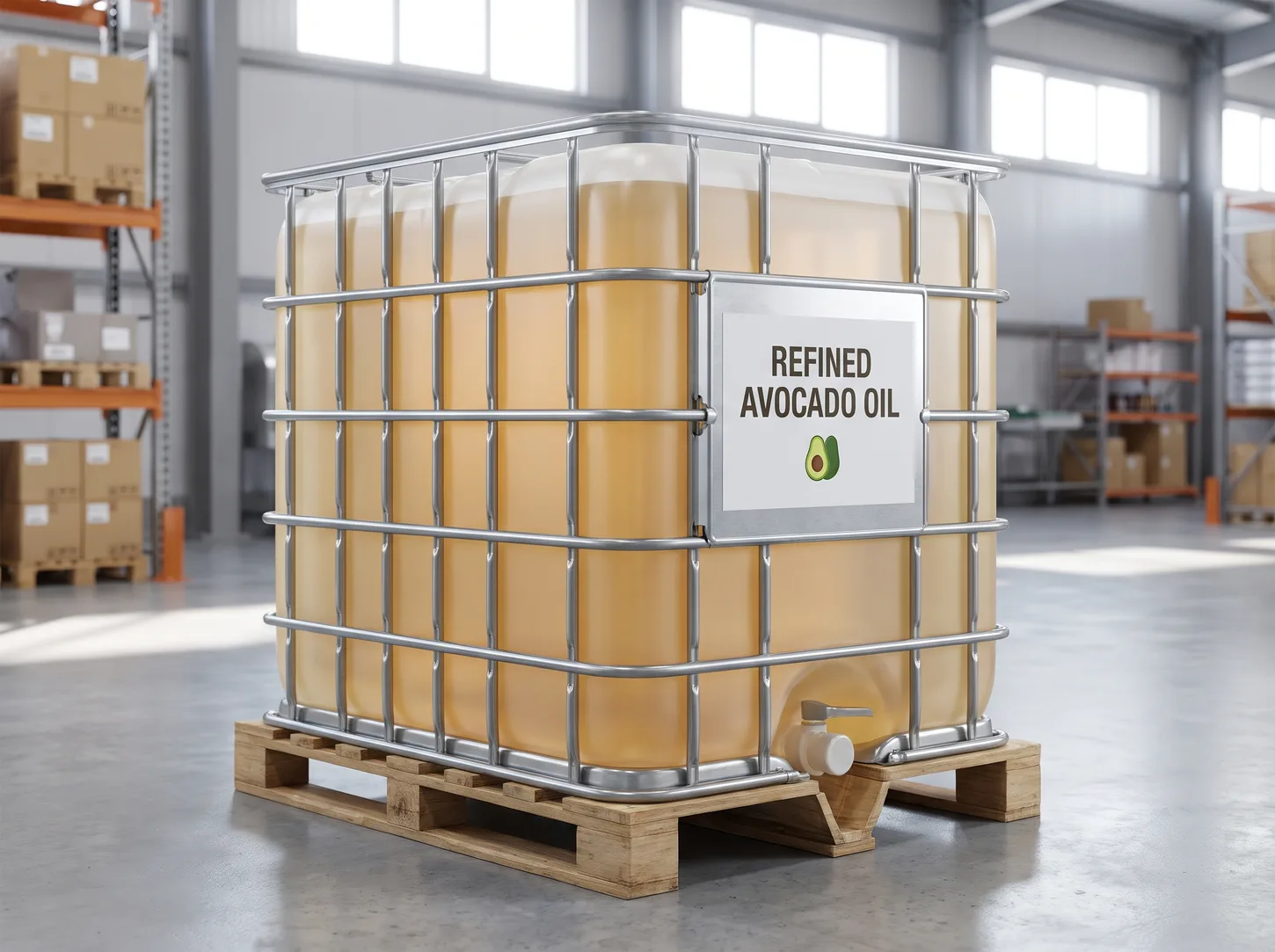
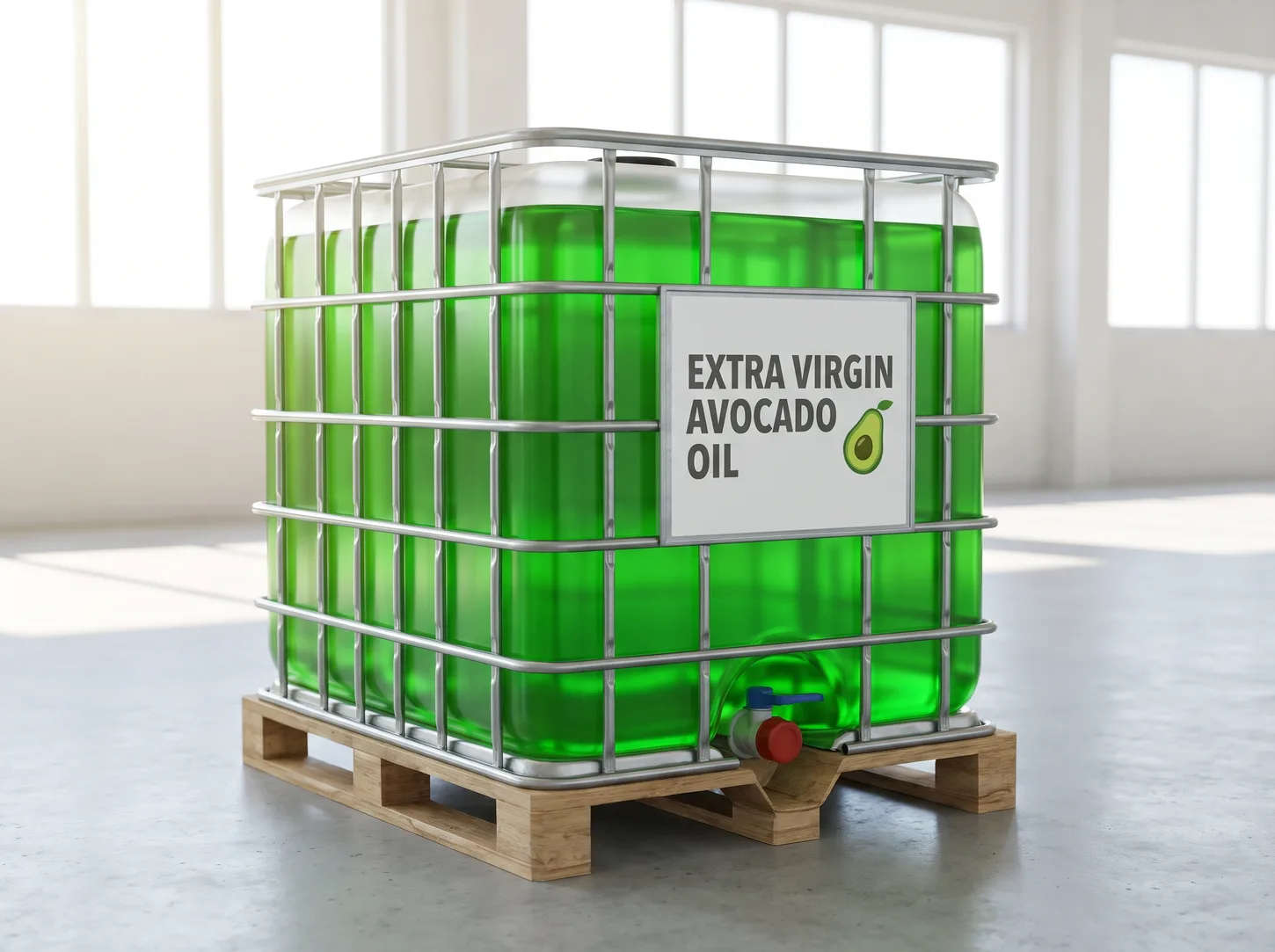
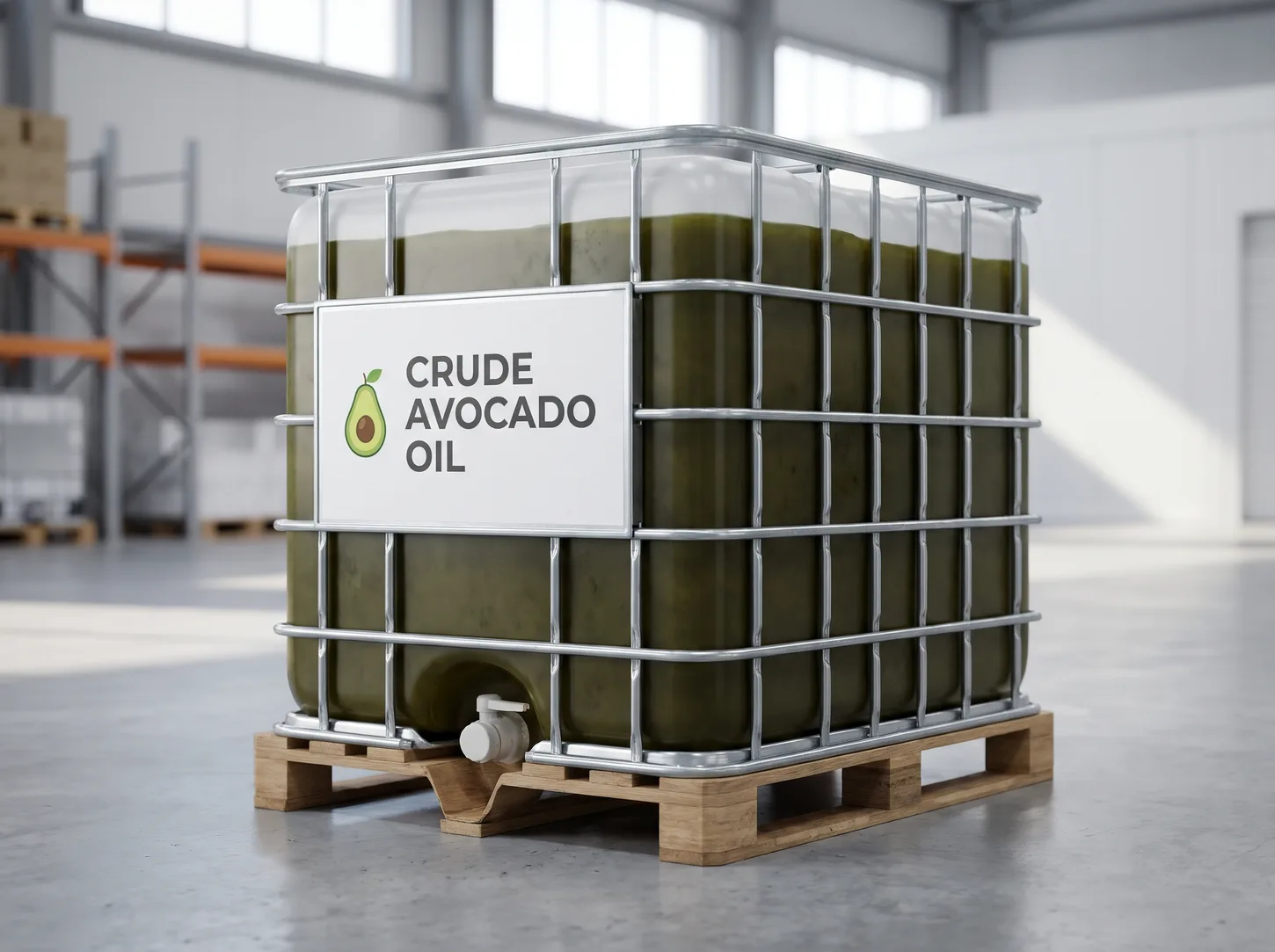
The short answer: crude avocado oil is the raw oil before any refining, refined avocado oil is crude oil that has been cleaned up to give a pale, mild oil, and extra virgin avocado oil is unrefined oil taken from good fruit by mechanical means only, so it keeps its green colour and fresh taste. When people compare refined vs unrefined avocado oil, they are really choosing between a neutral everyday oil and a flavourful one that is best used gently.
Below we explain how each type is made, how to tell them apart in the bottle, and which one suits which job.
What crude avocado oil is
Crude oil is the oil as it first comes out of the fruit, before any refining step. It still carries the free fatty acids, moisture, gums and other compounds that refiners take out later.
Crude oil is mainly a starting material. Refiners and manufacturers buy it to turn into refined oil or to use in their own products. Research on avocado oil shows why that refining step matters: in one study of screw-pressed avocado oil, the bleached oil had about 53% less free fatty acid and a 59% lower peroxide value than the crude oil it came from (Satriana et al., 2024). Those two numbers are common markers of how fresh and stable an oil is.
So crude avocado oil is not usually what you want for the home kitchen. It is what a refinery or a manufacturer works with.
What refined avocado oil is
Refined avocado oil starts as crude oil. Refining of vegetable oils usually involves degumming, bleaching and deodorisation (Verhe et al., 2006). In plain words, the oil is cleaned of gums, of colour and of strong smells and flavours, which leaves a light, even product.
UC Davis researchers describe refined avocado oil as light yellow and almost clear, because the pigments are removed during refining. Because deodorisation removes strong smells and flavours, its taste is mild and it stays in the background in most dishes.
Refining has a trade-off. It removes some of the natural minor compounds along with the flaws. Studies of vegetable oil refining report, for example, that the tocopherol (vitamin E) content goes down during refining (Verhe et al., 2006).
Where refined oil shines:
- Everyday cooking, where you want the oil to stay in the background.
- Recipes where a green colour or a buttery taste would not suit the dish.
What virgin and extra virgin avocado oil are
Virgin avocado oil is unrefined. The draft Kenya standard for virgin avocado oil (DKS 2995:2024, published by KEBS for comment) defines it as oil "obtained from avocado fruit without altering its nature". It may be made by mechanical means such as expelling or pressing, with or without heat, and without solvents. The only cleaning steps allowed are washing with water, settling, filtering and centrifuging.
The same draft describes extra virgin avocado oil as virgin oil from high quality fruit, with tighter limits. For example, it sets a maximum acid value of 2.0 mg KOH/g for extra virgin, against 4.0 for virgin, and a maximum peroxide value of 10 against 15.
According to UC Davis, fresh virgin avocado oil should be green and tastes grassy, buttery and a little like mushrooms. The exact flavour can vary with the avocado variety and the region.
Where extra virgin shines:
- Salad dressings and dips.
- Drizzling over food at the end of cooking, for example over sukuma wiki, beans or grilled vegetables.
- Gentle cooking, where you want the avocado taste to come through.
Refined vs unrefined avocado oil: a quick comparison
| Crude | Refined | Extra virgin | |
|---|---|---|---|
| Refined? | No (before refining) | Yes | No |
| Colour | Varies | Light yellow, almost clear | Green |
| Taste | Not meant for the table | Mild, neutral | Grassy, buttery |
| Best for | Refiners and manufacturers | Everyday cooking | Dressings, finishing, gentle cooking |
How to tell them apart when you buy
Labels are not always a safe guide. A UC Davis study of 22 avocado oils, published in the journal Food Control, found that at least 82% of the samples were either stale before their expiry date or mixed with other oils. Three bottles labelled "pure" or "extra virgin" were almost entirely soybean oil. The researchers noted that the US FDA had not adopted a standard of identity for avocado oil.
Standards are catching up. Work on an avocado oil standard at the Codex Committee on Fats and Oils began in 2017. As of late 2024, the standard for refined avocado oil was on the agenda for adoption, while the standards for virgin and extra virgin avocado oil were still under discussion.
Until then, your own senses help:
- Colour. Extra virgin should be green. Refined should be pale yellow and nearly clear.
- Smell and taste. Fresh virgin oil smells and tastes grassy and buttery. Oil that has gone off smells stale, which UC Davis compares to play dough.
- Dates and size. Buy a bottle you can finish while it is fresh, and pick the one closest to its production date.
- Storage. Keep the oil away from light and heat, in a cool, dark cupboard rather than next to the stove.
How Imara can help
At Imara Avocado Factory in Thika, Kenya, we make crude, refined, extra virgin and organic avocado oil, so you can choose the type that fits your use.
- For your shop or home: our own Imara brand bottles, from 5 pieces.
- For your own brand: private label in 250 ml, 500 ml and 1 L, as a bottle or a spray, from 100 bottles per SKU. See branding and bottling.
- For manufacturers and refiners: bulk oil from one full container, EXW Thika, with FOB, CFR or CIF on request. See wholesale and bulk.
Tell us what you are making and we will help you pick the right oil. Email us at support@imaraavocados.com.
FAQ
Is unrefined avocado oil better than refined? Neither is better for every job. Extra virgin keeps its colour, flavour and more of its natural minor compounds, so it suits dressings and finishing. Refined is mild and even, so it suits everyday cooking and products that need a neutral oil.
Why is my avocado oil green? A green colour is normal for virgin and extra virgin avocado oil. Refined avocado oil is pale because refining removes the pigments.
Can I cook with crude avocado oil? Crude oil is the raw material for refining, and refining removes free fatty acids, moisture and other compounds that affect its quality. For the kitchen, choose refined or extra virgin avocado oil.
Sources
- Kenya Bureau of Standards. Draft Kenya Standard DKS 2995:2024, Virgin avocado oil: Specification (public review draft).
- UC Davis College of Agricultural and Environmental Sciences. Study on avocado oil quality and purity (Green and Wang, Food Control).
- UC Davis. How to choose avocado oil (2020).
- Satriana, Syamsuddin, Y. and Supardan, M. D. (2024). Effect of refining process on some quality attributes of screw-pressed avocado oil. South African Journal of Chemical Engineering, 50, 20-26.
- Verhe, R., Verleyen, T., Van Hoed, V. and De Greyt, W. (2006). Influence of refining of vegetable oils on minor components. Journal of Oil Palm Research.
- The Shelby Report. Codex essentials: keeping up with changing avocado oil standards (November 2024).
Explore all avocado oil products · Refined avocado oil · Extra virgin avocado oil.