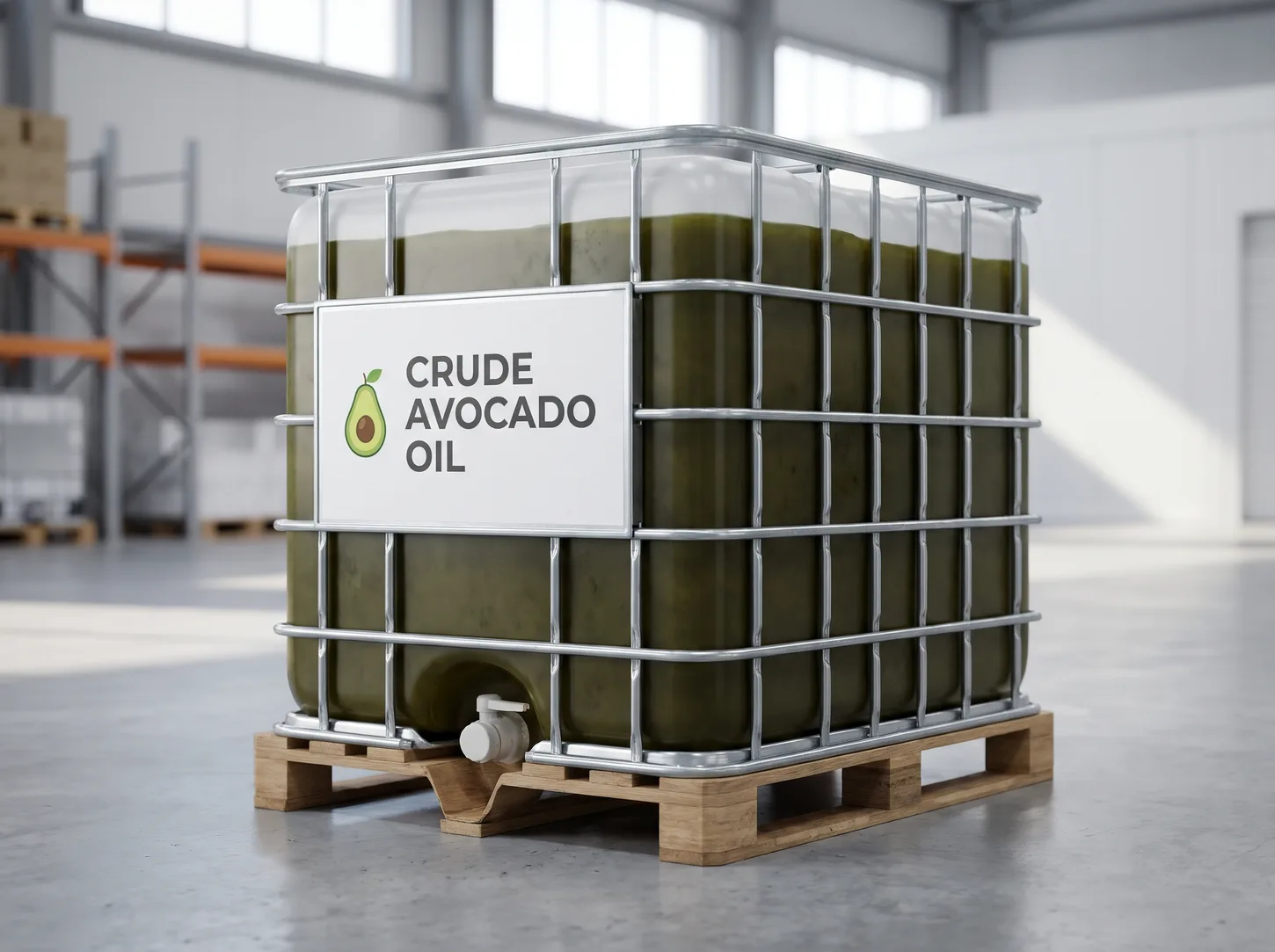
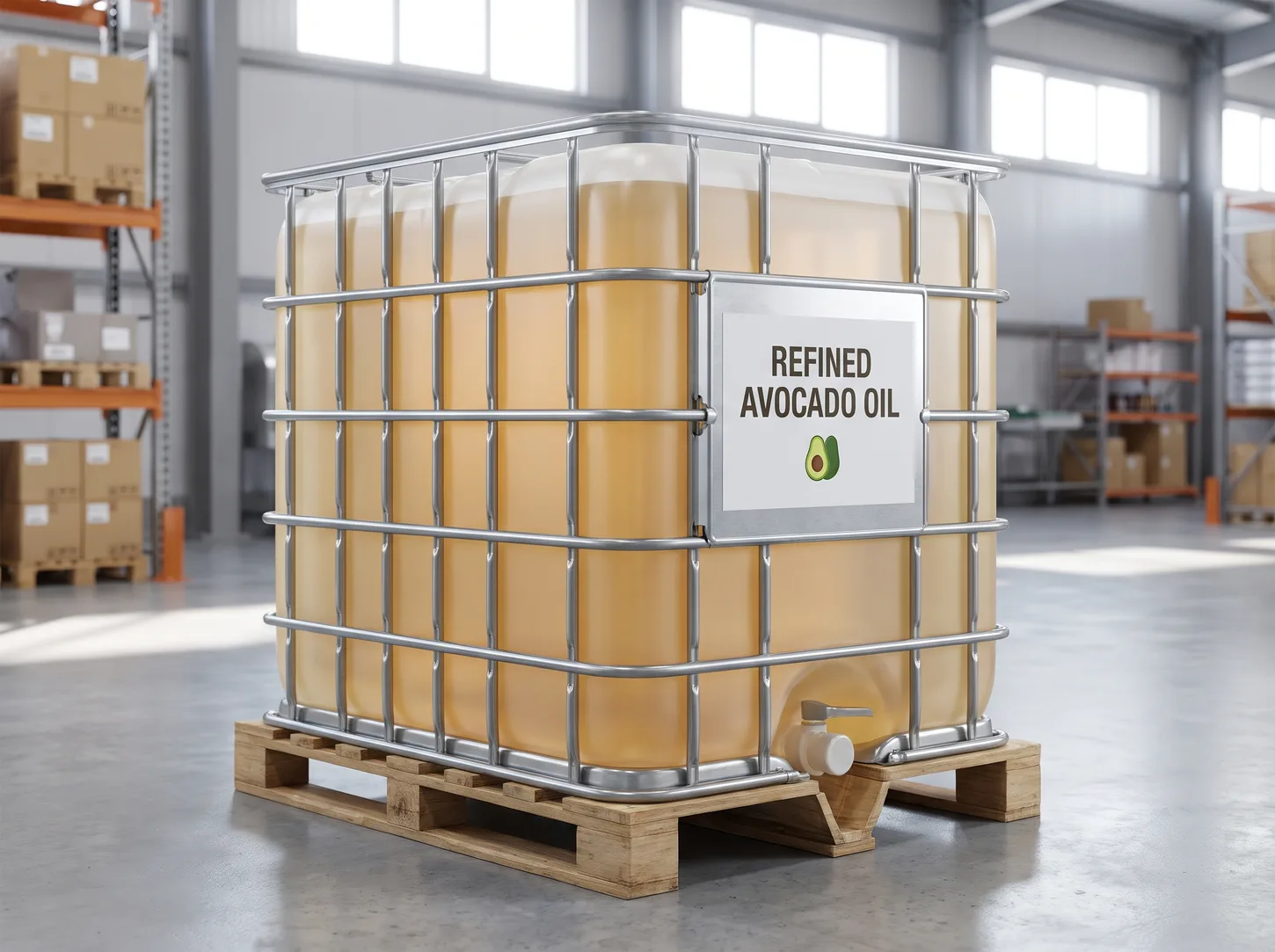
Avocado oil color mostly tells you how the oil was processed. Unrefined (extra virgin) avocado oil is usually green because it keeps natural chlorophyll and carotenoid pigments from the fruit, while refined avocado oil is pale yellow because bleaching during refining removes those pigments.
So a green oil and a pale oil can both be real avocado oil. They are simply different grades, made for different jobs. Below we explain where the color comes from, what changes it, and what color can and cannot tell you when you buy.
Where avocado oil color comes from
Avocado oil is pressed from the fruit, and the fruit itself is not one even color. In a study of Hass avocados published in the Journal of Agricultural and Food Chemistry, researchers measured pigments in the skin and in three layers of flesh: an outer dark green layer, a middle pale green layer and an inner yellow layer nearest the seed. The highest levels of all the pigments they measured were in the skin.
Two families of pigment do most of the work:
- Chlorophylls give the green. Food scientists writing for the American Oil Chemists' Society (AOCS) describe cold-pressed Hass avocado oil as "a brilliant emerald green when extracted" and link that color to the chlorophylls and carotenoids that pass into the oil.
- Carotenoids, including lutein, add yellow and golden tones.
The same AOCS article notes that most of the chlorophyll and carotenoids sit in the greener layers of flesh next to the skin, and that if skin is included in the pulp during processing, more pigment is likely to end up in the oil.
Why extra virgin avocado oil is green
Extra virgin avocado oil is not refined. It is extracted from the fruit mechanically and is not bleached. That means the pigments that dissolved into the oil stay there, which is why good extra virgin oil usually looks green, sometimes deep emerald and sometimes more olive or golden-green.
That color travels with the flavor. Unrefined oil also keeps more of the fruit's natural aroma, which is why extra virgin avocado oil tastes of avocado and is often chosen for dressings, dips and finishing. You can read more about this grade on our extra virgin avocado oil page.
Why refined avocado oil is pale yellow
Refining is a series of steps that clean the oil and make it neutral. One of them is bleaching, where the oil is mixed with an adsorbent clay and then filtered. Encyclopaedia Britannica explains that many impurities, "including chlorophyll and carotenoid pigments", stick to these agents and are removed by filtration. The AOCS describes bleaching in the same way: it removes some of the color and reduces the chlorophyll content of the oil.
After bleaching and deodorizing, avocado oil is light yellow with a mild taste. The AOCS article on avocado oil notes that oil for skin care products is usually refined, bleached and deodorized, which leaves an odorless yellow oil.
Pale does not mean empty or fake. It means the oil was refined on purpose, for a neutral taste and a consistent look. If you want the full picture of the two styles, see our guide to refined vs unrefined avocado oil.
Avocado oil color by grade: a quick guide
| Grade | Typical color | Why | Common uses |
|---|---|---|---|
| Extra virgin | Green to emerald, sometimes golden-green | Not refined, so natural chlorophylls and carotenoids stay in the oil | Dressings, dips, drizzling, flavor-led recipes |
| Refined | Pale yellow | Bleaching removes much of the pigment; deodorizing removes aroma | Everyday cooking, baking, neutral-taste foods, cosmetics |
| Crude | Varies | Not yet refined, so pigments and other natural components remain | Raw material for refining, not a finished table oil |
| Organic | Depends on grade | "Organic" is a certification, separate from the grade; organic oil can be extra virgin or refined | As for the matching grade |
What else can change the color
Even within one grade, avocado oil color is not fixed. A few things make a difference:
- Which parts of the fruit end up in the oil. Because the outer flesh and the skin hold the most pigment, how much of them goes into processing affects how green the oil turns out (AOCS).
- Ripening. In the Hass study, the overall levels of carotenoids and chlorophylls in the flesh did not change significantly as the fruit ripened, but chlorophyll in oil taken from the skin fell as the skin turned from green to purple-black.
- Light and time. The AOCS notes that chlorophyll can act as a sensitizer for photo-oxidation, so avocado oil should be stored away from light.
- Refining choices. How much bleaching an oil gets decides how pale it ends up. Refineries monitor color and chlorophyll as part of quality control (AOCS).
What color can and can't tell you when you buy
Color is a useful first clue, but it is not a quality test on its own.
Color can tell you:
- Whether the oil is likely unrefined (green) or refined (pale).
- Roughly what taste to expect: green oils taste more of avocado, pale oils are mild.
- Whether a label matches the bottle. An oil sold as "extra virgin" that looks pale and tastes of nothing is worth questioning.
Color can't tell you:
- Whether the oil is fresh. Freshness depends on age, storage and handling, so check the date and the smell.
- Whether it is unblended. A pale oil could be refined avocado oil or a blend; only testing and a trustworthy supplier can confirm that. Our article on how to tell if avocado oil is real explains what to look for.
- Which grade is "better". Green and pale oils are made for different jobs. The right one depends on what you are cooking or making.
For brands and buyers, the practical step is to agree the grade first, then ask your supplier for the specification of that grade and how it is tested.
How Imara can help
At Imara Avocado Factory in Thika, Kenya, we make crude, refined, extra virgin and organic avocado oil, and we refine in our own refinery in Thika. That means we can talk you through which grade suits your product, whether you want the green, fruity character of extra virgin or the pale, neutral profile of refined oil.
- Bulk: from one container (23 t, one flexitank).
- Private label: 250 ml, 500 ml and 1 L, in a bottle or spray, from 100 bottles per SKU.
- Imara brand: from 5 pieces.
- Shipping terms: EXW Thika, with FOB, CFR or CIF on request.
We hold an AFA export licence (Kenya) and China GACC registration, and our organic oil is certified. To discuss grades for your next order, visit our wholesale page or email our team at support@imaraavocados.com.
FAQ
Should avocado oil be green?
Unrefined (extra virgin) avocado oil is usually green because it keeps natural chlorophyll from the fruit. Refined avocado oil is meant to be pale yellow. Both colors are normal for their grade.
Is green avocado oil better than yellow avocado oil?
Not automatically. Green oil has more avocado flavor and keeps its natural pigments; pale refined oil is neutral in taste and look. Choose by use: flavor-led dishes suit extra virgin, everyday neutral cooking and many cosmetic formulas suit refined.
Why is my refined avocado oil so pale?
Refining includes a bleaching step that removes chlorophyll and carotenoid pigments, and deodorizing removes most of the aroma. The result is a light yellow, mild oil.
Does the color of avocado oil change over time?
It can. Light and time affect oils, and chlorophyll can make oil more sensitive to light-driven oxidation, so keep your oil sealed in a cool, dark place.
Can I tell if avocado oil is real just by its color?
No. Avocado oil color hints at the grade, but it can't prove an oil is fresh or unblended. Buy from a supplier who can tell you the grade and how the oil is tested.
Sources
- Wong, M., Requejo-Jackman, C. and Woolf, A. "What is unrefined, extra virgin cold-pressed avocado oil?" American Oil Chemists' Society (AOCS), INFORM, April 2010.
- Ashton, O.B.O., Wong, M., McGhie, T.K., et al. "Pigments in Avocado Tissue and Oil." Journal of Agricultural and Food Chemistry, 54(26), 10151–10158, 2006. doi:10.1021/jf061809j
- Encyclopaedia Britannica. "Fat processing: Processing of extracted oil."
- Brooks, D.D., Berbesi, R. and Hodgson, A.S. "Optimization of Bleaching Process." AOCS Lipid Library.
Explore all avocado oil products · Crude avocado oil · Refined avocado oil.