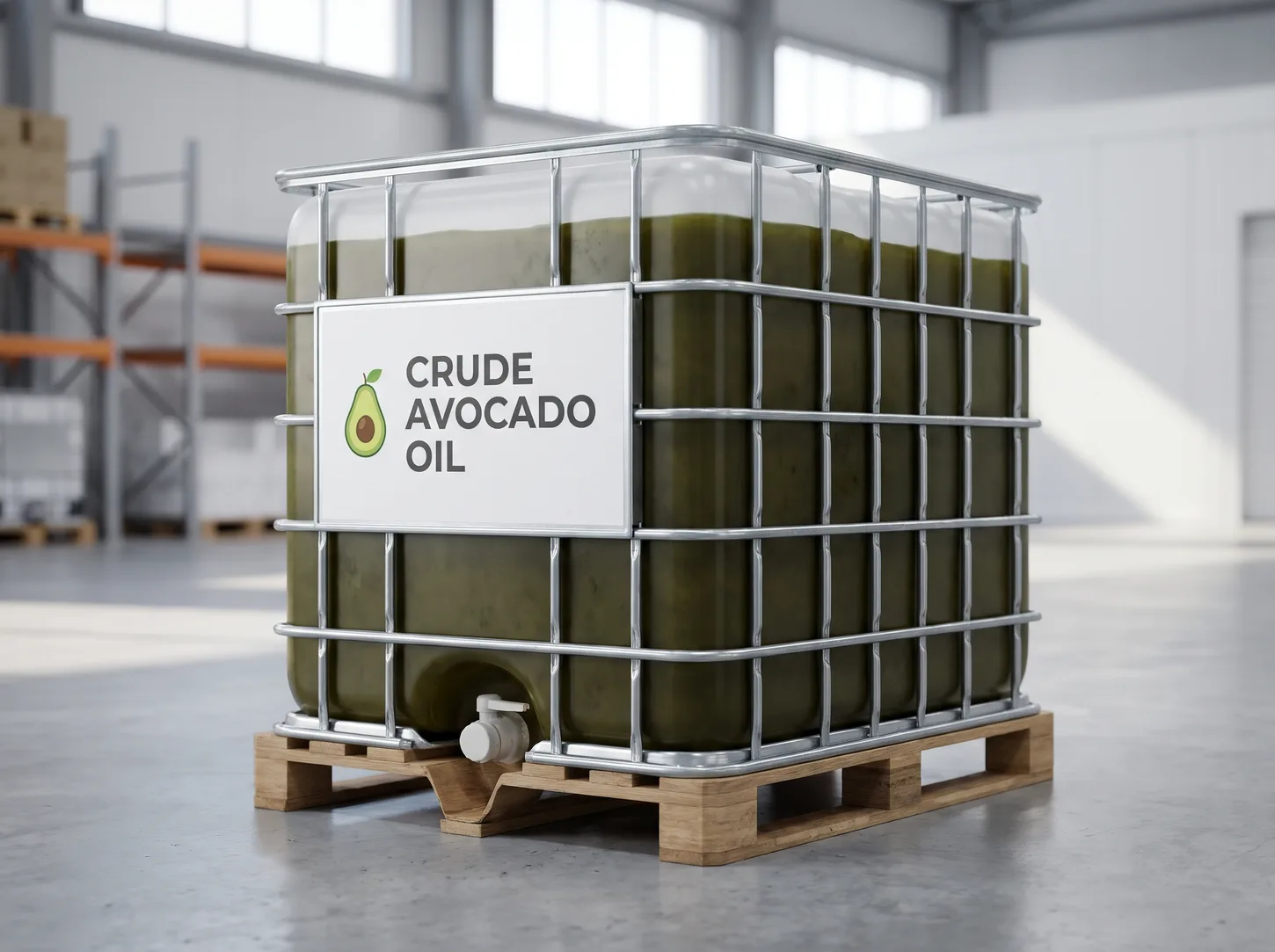
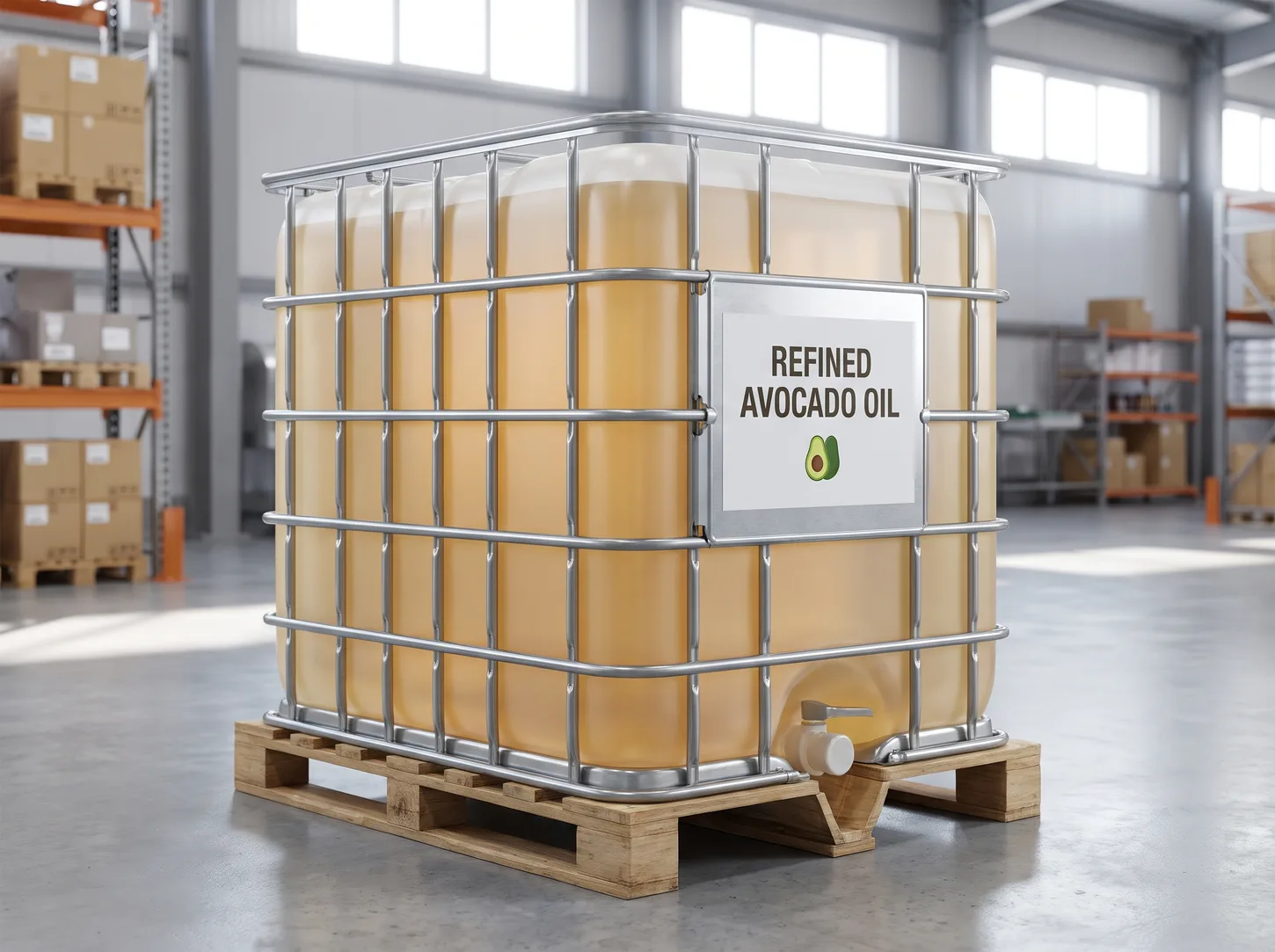
Order bulk avocado oil if you will fill, blend or manufacture at your own site. Choose private label if you want finished bottles under your own brand, and wholesale if you want to resell a finished brand in smaller quantities. The right route depends on three things: how much oil you can move, whose name goes on the label, and who handles the oil after it leaves the factory.
Many buyers start by searching for the biggest quantity and the lowest unit cost. But the size of an order is only part of the decision. Each route also moves work and responsibility between you and your supplier, so it helps to compare them side by side.
Wholesale, private label or bulk: the quick comparison
| Wholesale | Private label | Bulk | |
|---|---|---|---|
| What you buy | Finished bottles under the maker's brand | Finished bottles under your brand | Oil only, with no retail packaging |
| Name on the label | The maker's | Yours | Yours, on whatever you fill later |
| Who fills it | The maker | The maker | You or your own packer |
| Best for | Shops, kitchens and first orders | New and growing brands | Food, cosmetic and bottling companies |
| Main job for you | Selling | Brand, label and selling | Storage, filling, testing and compliance |
| Minimum at Imara | 5 pieces (Imara brand) | 100 bottles per SKU | 1 container (23 t, one flexitank) |
When wholesale makes sense
Wholesale is the simplest route. You buy a finished product, put it on your shelf or use it in your kitchen, and reorder when you run low.
It suits a shop testing whether customers will buy avocado oil, a restaurant that wants oil for its own use, or a reseller who would rather sell an established product than build a new one. You don't design a label or plan a production run, and your money is not tied up in stock under your own name.
The trade-off is that the brand belongs to someone else. You can build a good business selling it, but the customer's loyalty stays with the brand on the bottle.
When private label makes sense
Private label means the oil and the bottling come from a supplier, while the brand is yours. You get a finished product without running a filling line.
This suits a food brand adding an oil to its range, a retailer building a house brand, or a beauty company selling oil to its customers. Before you order, you will need to decide on the oil, the bottle size, the format and the label.
Two points deserve care:
- Your label carries legal weight. The Codex general labelling standard asks for, among other things, a name that shows the true nature of the food, the name and address of the manufacturer, packer, distributor, importer, exporter or vendor, lot identification and date marking. Country of origin must be declared if leaving it out would mislead the consumer. Check the rules in each market you sell in, as they can go further.
- Your name carries the quality risk. When UC Davis researchers tested 36 private label avocado oil products from retailers in the US and Canada, only 36% of samples were of advertised quality. Agree the grade in writing and ask how your oil will be checked, whichever supplier you use.
SKU means one version of a product, so each oil and size you plan to sell usually counts as its own SKU. Starting with fewer SKUs keeps your first order easier to manage.
When bulk avocado oil makes sense
Bulk avocado oil suits a business that already has somewhere to put it: a bottling line, a food factory, a cosmetics plant or a blending site. You buy the oil itself and take on everything that happens to it afterwards.
One way to ship bulk oil is a flexitank. This is a flexible, single-use bag fitted inside a standard 20-foot shipping container, and shipping line MSC lists edible oil among the liquids it can carry. A flexitank holds many thousands of litres, so one container is a large commitment.
Before ordering, check that you can receive that much oil in one delivery, and that you can use it while it is still fresh. Air and heat both speed up the oxidation that spoils oil, so a good price is no help if the last of the container sits too long.
The Codex code of practice for edible oils in bulk gives useful guidance for your own tanks:
- Tanks should be clean and dry before use.
- Stainless steel is the most preferred metal for tanks.
- Copper and its alloys, such as brass and bronze, should not be used.
- Keep contact with air low, and carry out each step at the lowest practicable temperature.
Importing also brings paperwork, in bulk or in bottles. In the US, for example, the importer must have a Foreign Supplier Verification Program for each food and each foreign supplier. The importer is the US owner or consignee of the food or, if there is none, a US agent or representative, so settle who holds this role before the oil ships.
Three questions to help you decide
- Can you fill and store the oil yourself? If not, bulk is the wrong route for now. Wholesale or private label will suit you better.
- Do you want to own a brand? If yes, look at private label first. If you only want a good product to sell or use, start with wholesale.
- How quickly will you use it? Choose the size of order that you can sell or use while the oil is fresh, not the largest one on offer.
Many buyers move through these routes over time. A shop might start with wholesale, launch its own label once it knows what sells, and move to bulk after setting up its own filling.
How Imara can help
We are Imara Avocado Factory in Thika, Kenya. We supply crude, refined, extra virgin and organic avocado oil, and all three routes are open to you:
- Wholesale: the Imara brand from 5 pieces.
- Private label: 250 ml, 500 ml and 1 L, as a bottle or spray, from 100 bottles per SKU.
- Bulk: from 1 container (23 t, one flexitank).
We source our avocados from our own farms and partner farms, and we refine the oil in our own refinery in Thika. We quote EXW Thika, with FOB, CFR and CIF on request.
See our wholesale and bulk options or our private label service, or contact our team with the oil and quantity you have in mind.
FAQ
What is the minimum order for bulk avocado oil? It varies by supplier. At Imara, the minimum is 1 container, which is 23 t in one flexitank.
Is bulk avocado oil the same as wholesale? Not quite. Bulk is oil without retail packaging, ready for you to fill or use in your own products. Wholesale is finished bottles bought in quantity to resell or use.
Can I start with private label and move to bulk later? Yes. You would need your own filling and storage, or a packer you trust, before you make the move.
Do I need my own brand to buy in quantity? No. Wholesale lets you buy a finished brand. At Imara, that starts from 5 pieces of the Imara brand.
Sources
- Codex Alimentarius, Code of Practice for the Storage and Transport of Edible Fats and Oils in Bulk (CAC/RCP 36-1987, revised 2015)
- Codex Alimentarius, General Standard for the Labelling of Prepackaged Foods (CODEX STAN 1-1985)
- US Food and Drug Administration, FSMA Final Rule on Foreign Supplier Verification Programs for Importers of Food for Humans and Animals
- University of California, Davis, "Nearly 70% of private label avocado oil rancid or mixed with other oils", news release, 24 May 2023, on the Food Control paper "Purity and quality of private labelled avocado oil"
- MSC, "Flow State: How Flexitank Containers are Advancing Liquid Cargo Shipping", 2025
Explore all avocado oil products · Crude avocado oil · Refined avocado oil.